¿Quieres un teclado ergonómico para trabajar y jugar? El Kinesis mWave podría ser tu elección ideal, a pesar de sus defectos.

 Ergonomic keyboards make a lot of sense if you're someone who spends all day behind a computer and then uses the same rig to game during the evening. Split keys, tenting, and tilting might be alien terms to many a PC user, but once you've made the jump, you'll wonder why you stuck with the traditional layout for so long.
That said, some keyboards are anything but friendly to the first-time ergo user (the Dyma Defy and ZSA Moonlander spring to mind here), but here's one that's designed very much with newbies in mind. Kinesis is no stranger to the world of ergonomics, and its Freestyle Edge is still the best ergonomic keyboard for gaming.
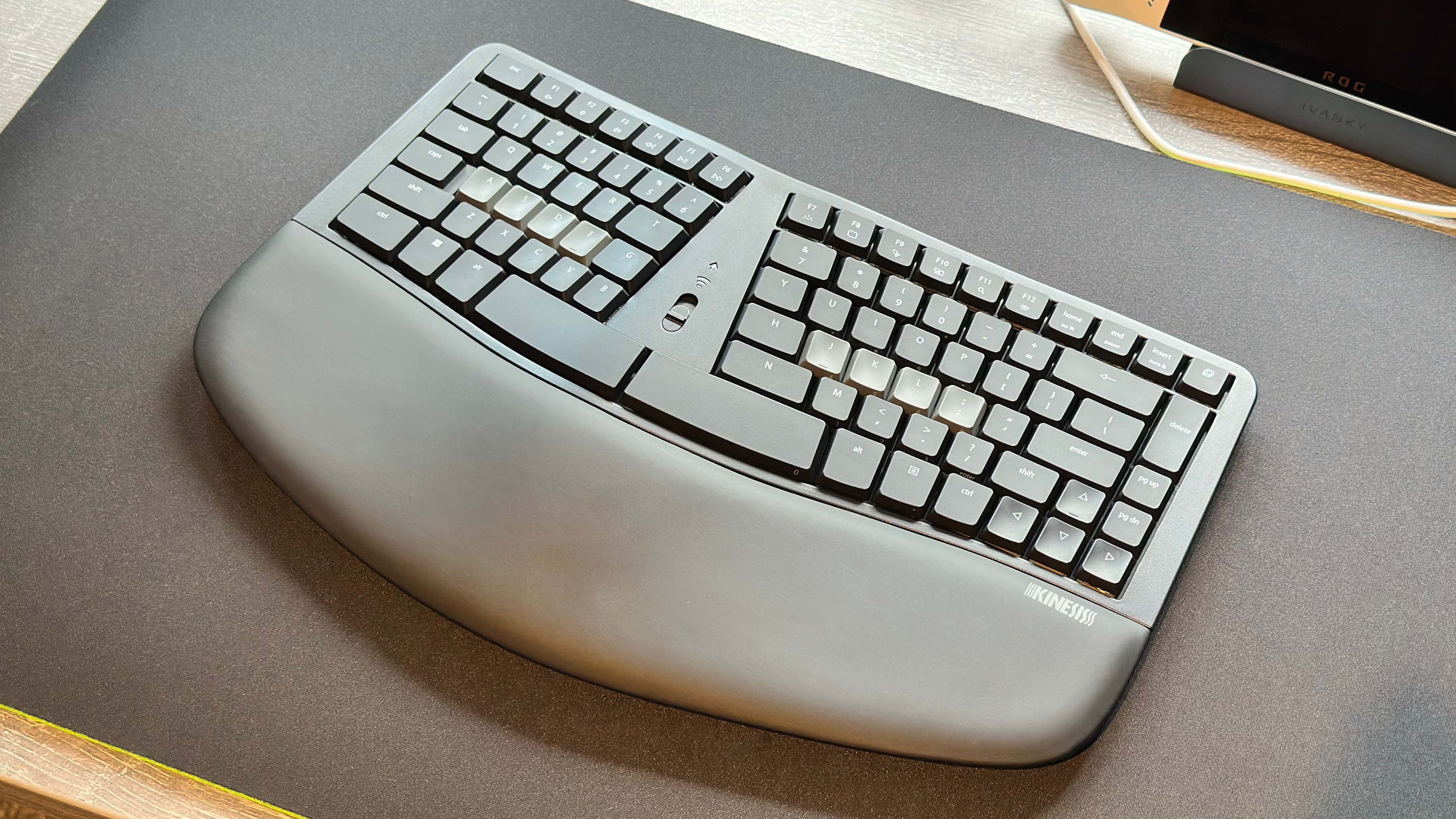
The mWave is Kinesis' take on Microsoft's ergonomic keyboards, but one can also throw the Logitech K860 into the ring, as it's quite similar in design. What sets the mWave apart from the competition is the use of low-profile mechanical key switches, which makes for a more responsive typing experience than the membrane systems used by Logitech and Microsoft.
- Keychron M5 review
- Best gaming keyboards in 2025: the fastest, smoothest and loveliest boards I've tested
- Corsair K70 Pro TKL gaming keyboard review
Switches: Gateron Low Profile (KS-33 2.0)
Tienes que jugar a Cryptmaster, pero no uses un teclado compacto.
¿Quieres trabajar en Glastonbury 2023? Están contratando cocineros y ayudantes de catering
Keys: 85 in total, fully remappable
Connectivity: wired (USB Type-C) / Bluetooth Low Energy (two profiles)
Split: One-piece chassis, fully split keyboard
Tenting: permanent, non-linear
Tilting: optional kit, negative only
Lighting: White LED backlight, wired mode only
Media controls: shortcuts via alternate key mode
Weight: 0.91 kg / 2.0 lbs
Mechanical switches are also better for gaming, and while the mWave is very much not marketed at the gaming crowd, the fact that the Gateron switches require little force and travel to actuate makes them quite handy for a frantic round of Counter-Strike or Fortnite.
One difference between the mWave and the likes of the K860 is that it's not a full-sized keyboard. Kinesis does sell a separate, wireless number pad, but at a few cents shy of $70, it's arguably not worth buying. Like so many compact ergonomic keyboards, numpad and media keys are accessed via a second 'layer'—a dedicated key flips between different key mappings to activate them.
What is likely to make some people initially baulk at the mWave, though, is its overall ergonomic design. The key split is quite wide—wider than the K860—and the tenting is non-linear. By this, I mean that rather than the keyboard rising by a constant angle in the middle, they curve upwards slightly in the mWave.
These two aspects make it a little harder to get to grips with, and even though I've used ergonomic keyboards for many years, it took me longer to get used to the mWave than it did for the K860 or even Kinesis' Freestyle Edge. While my left hand settled in place perfectly, my right hand kept falling a little too close to the middle.
That resulted in me constantly hitting K instead of L, for example, and I was a little surprised by how long it took me to stop doing this. Tilting is negative-only (i.e. you can raise the wrist rest upwards) and it requires you to magnetically attach little legs. It sounds a bit rubbish, but it actually works quite well, though I'd prefer to have an integrated system.